
← Your daily dose of motivation
152 quotes, page 1 of 6Starting something of your own
For the van owner, the sole trader, the first employee hired and anybody building a business from a spare room. About customers and effort, never easy money.
We say who really said each one, and where the credit is uncertain we tell you. Every card is ours to share.
“The only foundation of real business is service.”
Henry Ford, My Life and Work (1922)
A window cleaner with one round and a bucket has a real business the day the customers would miss him if he stopped coming.

“Business exists for service.”
Henry Ford, My Life and Work (1922)
Before the logo, the van wrap and the website: write down in one line what you do for the customer. That line is the business.
“Time spent in fighting competition is wasted; it had better be spent in doing the work.”
Henry Ford, My Life and Work (1922)
The cafe across the road will always be there. An hour on your own coffee and your own queue beats an hour worrying about theirs.
“Thinking is the hardest work any one can do, which is probably the reason why we have so few thinkers.”
Henry Ford, My Life and Work (1922). The book joins the two halves with a dash; he said much the same to The Forum magazine in 1928.
Running a small firm is mostly doing, so book half an hour a week to think: which jobs paid, which ones cost you, what to stop.
“A man cannot expect to progress without thinking.”
Henry Ford, My Life and Work (1922)
The sole trader who sits down with last year's invoices on a Sunday usually knows which customers to keep and which to let go.
“If he intends to go forward and do anything, the whistle is only a signal to start thinking over the day's work in order to discover how it might be done better.”
Henry Ford, My Life and Work (1922)
Plenty of cleaning firms and haulage outfits started as a worker's notes on how the job could be run better than the place they worked.
“If the machine does not give service, then it is better for the manufacturer if he never had the introduction, for he will have the worst of all advertisements: a dissatisfied customer.”
Henry Ford, My Life and Work (1922). The book has a dash before the last three words.
A small firm lives on word of mouth, and it travels both ways. Go back and put the botched job right before you chase the next one.
“The service must be the best you can give.”
Henry Ford, My Life and Work (1922)
A van, a phone and a reputation for turning up on time: in a crowded trade that last one is what gets you the repeat work.

“It is the product that pays the wages and it is the management that arranges the production so that the product may pay the wages.”
Henry Ford, My Life and Work (1922). The poster line "it is the customer who pays the wages" is a later paraphrase; this is what the book says, a sentence after "He only handles the money".
Before you take on your first employee, check the work coming in will cover their pay, holiday, employer NI and pension, not just this month but next.
“Being greedy for money is the surest way not to get it.”
Henry Ford, My Life and Work (1922). The sentence goes on to say that money looks after itself when you serve for the sake of service.
Overcharge a new customer once and you have lost ten years of their trade. Price fairly and let the regulars build up.
“There are always enough people ready and anxious to buy, provided you supply what they want and at the proper price.”
Henry Ford, My Life and Work (1922). He adds that it applies to personal services as well as to goods.
Starting a cleaning or gardening round? Ask ten neighbours what they would pay for and how often. Their answers are your first price list.
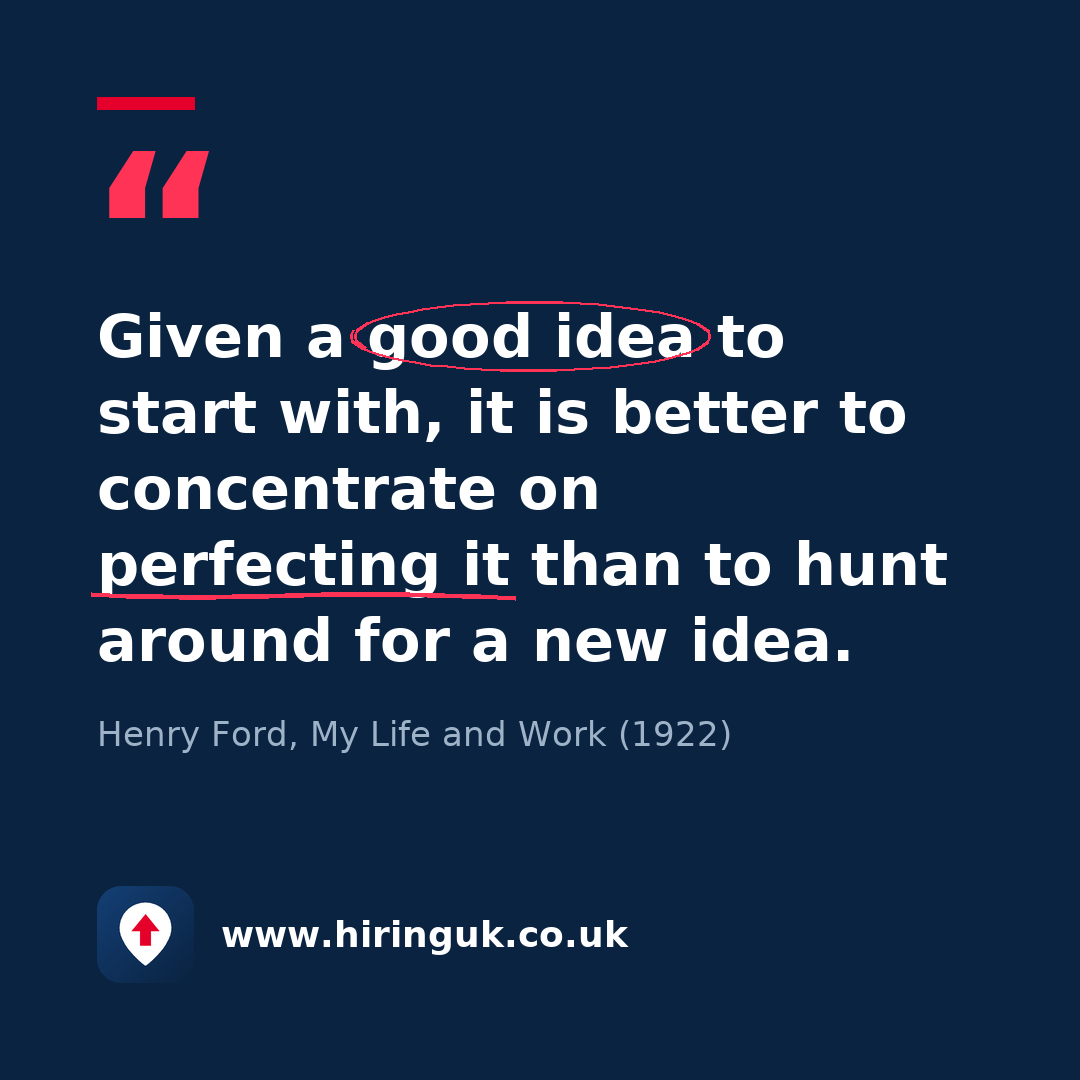
“Given a good idea to start with, it is better to concentrate on perfecting it than to hunt around for a new idea.”
Henry Ford, My Life and Work (1922)
One service done very well (end of tenancy cleans, say, or same day pallets) beats a menu of ten done so-so.
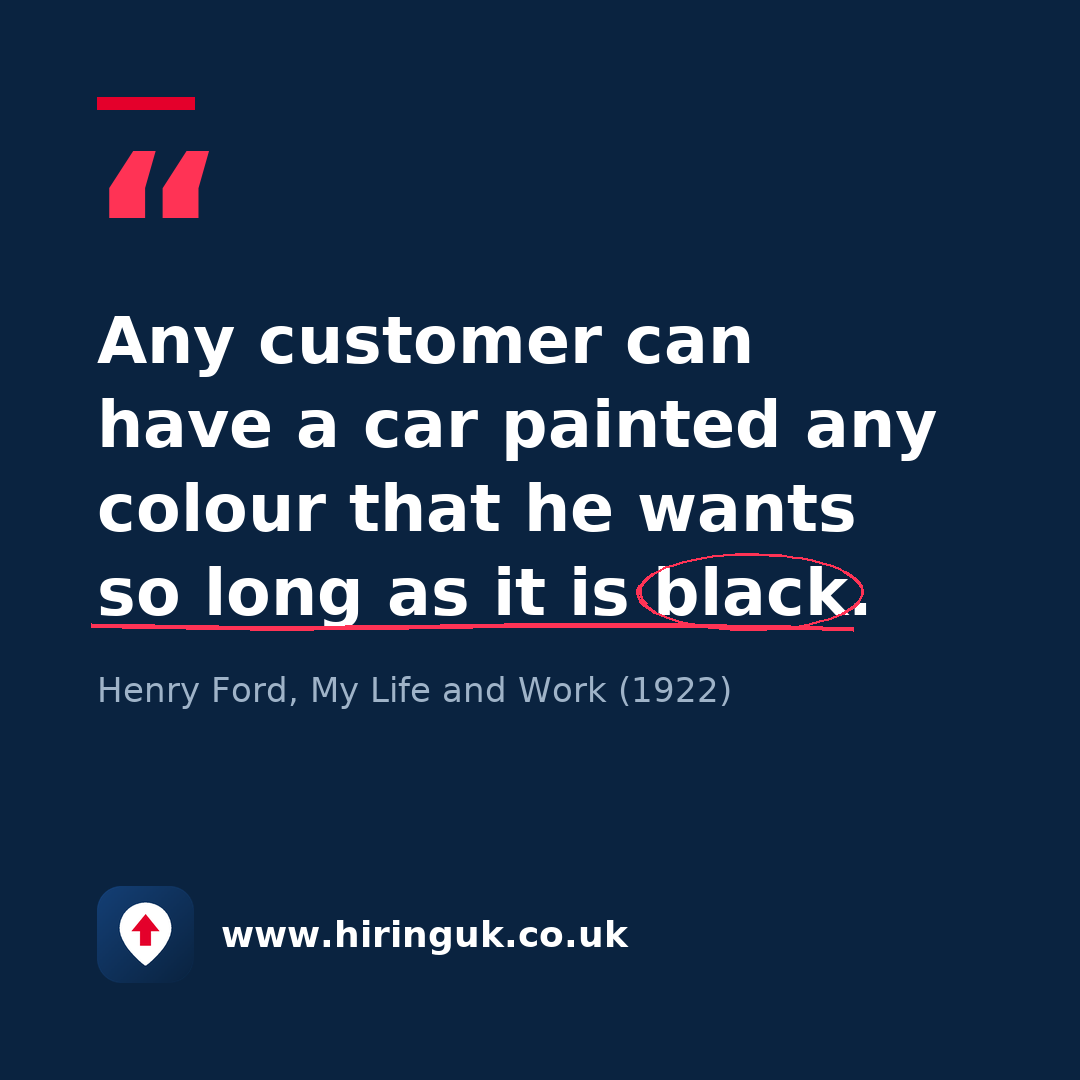
“Any customer can have a car painted any colour that he wants so long as it is black.”
Henry Ford, My Life and Work (1922). In the book he dates it to 1909, when he decided to make only the Model T; one model kept the price down.
Saying no to the odd jobs that wreck your day is allowed. A short, clear list of what you do is easier to sell and to deliver.
“One cannot have morale without cleanliness.”
Henry Ford, My Life and Work (1922)
A tidy yard, a clean van and a staff room that is cleaned every day tell a new starter more about you than the induction does.
“The employer who is seriously trying to do his duty in the world must be a hard worker.”
Henry Ford, My Life and Work (1922)
Your first employee will copy what you do, not what you say. Be on the job when you ask them to be.

“Put all good eggs in one basket and then watch that basket.”
Andrew Carnegie, Autobiography of Andrew Carnegie (1920). He turned the old proverb round on purpose, and said the same in a talk to students in Pittsburgh in 1885.
A one van firm with one big customer is not wrong to focus. Just watch that contract closely and keep a second customer warm.


“I believe the true road to preëminent success in any line is to make yourself master in that line.”
Andrew Carnegie, Autobiography of Andrew Carnegie (1920)
Be the best tiler in the town before you become a building firm. Skill is the cheapest marketing there is.

“There is one imperative rule for men in business: no secrets from partners.”
Andrew Carnegie, Autobiography of Andrew Carnegie (1920). The original has a dash before the rule.
Going into business with a friend? Write down who puts in what, who decides what, and how either of you can leave, before the first invoice.
“A mistake made by any one in favor of the firm is corrected as promptly as if the error were in favor of the other party.”
Andrew Carnegie, Autobiography of Andrew Carnegie (1920)
Overcharged a customer by mistake? Ring them before they notice. Underpaid a worker? Put it right in the next pay run. Both build trust.

“I have never known a concern to make a decided success that did not do good, honest work.”
Andrew Carnegie, Autobiography of Andrew Carnegie (1920)
Cutting corners on a cleaning contract shows within a month. Doing it properly shows within a year, in the referrals.

“We were friends first and partners afterwards.”
Andrew Carnegie, Autobiography of Andrew Carnegie (1920)
The best business partners are often people you have already worked a hard week beside. You know how they act when things go wrong.


“My experience has been that no partnership of new men gathered promiscuously from various fields can prove a good working organization as at first constituted.”
Andrew Carnegie, Autobiography of Andrew Carnegie (1920). "Promiscuously" here has its old meaning: gathered at random.
A brand new team needs a few months to settle. Plan the first busy season with that in mind, and do not judge your hires on week one.
“Nothing tells in the long run like good judgment.”
Andrew Carnegie, Autobiography of Andrew Carnegie (1920). He goes on to warn that a mind taken up with share prices loses it.
Turning down a job that would stretch the van, the crew or the cash too far is a skill. It rarely feels like one at the time.
“Commit to your business. Believe in it more than anybody else.”
Sam Walton, Made in America (1992), rule 1 of his ten rules for building a business
Nobody will push your new agency or cafe harder than you. If you are lukewarm about it, customers will be too.
“Share your profits with all your associates, and treat them as partners.”
Sam Walton, Made in America (1992), rule 2
Even a small firm can share a good year: a bonus, an extra day off, a say in the next van. People look after what they feel part of.


“Communicate everything you possibly can to your partners.”
Sam Walton, Made in America (1992), rule 4
Tell your crew when work is quiet and when a big contract lands. People cope with bad news far better than with silence.

“Appreciate everything your associates do for the business.”
Sam Walton, Made in America (1992), rule 5
A thank you on the group chat after a long Saturday costs nothing and is remembered on the next long Saturday.

“Listen to everyone in your company.”
Sam Walton, Made in America (1992), rule 7
Your drivers and cleaners talk to customers more than you do. Ask them what people complain about; it is free market research.


“Exceed your customers' expectations.”
Sam Walton, Made in America (1992), rule 8
Arrive when you said, finish when you said, leave it cleaner than you found it. In most trades that alone is above expectations.


“Control your expenses better than your competition.”
Sam Walton, Made in America (1992), rule 9
Fuel, insurance, phone contracts, software you forgot you pay for: check them every quarter. Small leaks sink small firms.

Other sections
- Work and keeping going (189)
- Starting a business (152)
- For leaders (41)
- Working with people (22)
- Mindset and habits (144)
- True stories of people who started small